Companies and industries are adopting environmentally friendly practices. This helps reduce climate-damaging greenhouse gas emissions. The positive results are evident.
Brazil is a leader in clean energyIts energy matrix is 83% renewable, well above the global average. This shift not only protects the environment but also creates new economic opportunities.
Sectors such as the chemical and paper industries are demonstrating efficiency. They have managed to significantly reduce emissions. Programs such as Procel are also focused on energy efficiency, saving billions of kWh.
Programs like the Alliance are essential for the future. They help prevent CO2 emissions and highlight Brazil as an environmental leader. These actions demonstrate that Brazil is on the right path to a low-carbon economy.
Recent studies confirm that the low-carbon economy in Brazil is making progress. It goes beyond the goals of the UN Global Compact. It shows that it is possible to live in harmony with the environment.
Challenges and Opportunities in Implementing the Low Carbon Economy
The transition to a low-carbon economy In Brazil, it's a complex challenge. Significant investment in research and development is needed. This is essential to create innovations that help reduce emissions in key areas such as energy, agriculture, and industry.
On the other hand, this economic shift brings many opportunities. It creates green jobs, improving the workforce and economic growth. Events by the National Confederation of Industry (CNI) demonstrate the importance of the energy transition and sustainable practices. They help align forest conservation and industrial innovation with the goals of the Paris Agreement.
To meet international targets, Brazil needs strong public policies. It is necessary to halve greenhouse gas emissions by 2030. Furthermore, achieving carbon neutrality by 2050 requires strategies that promote conservation and innovation.
Brazil has a clean energy matrix, with nearly 45% from renewable sources. This puts the country in a good position to lead the green economy. It's crucial to have national strategies that leverage natural and human resources to stand out. low-carbon economy.
Although there are challenges, the chances of creating a sustainable and dynamic society are real. This opens a promising path for Brazil's socioeconomic future in the global arena. sustainability.
Energy Transformation: The Role of Renewable Energy
Brazil is shifting to a lower-carbon economy. energy transformation is essential, with a focus on renewable energy. The country is using more solar energy, wind power and hydroelectric. It is also exploring the geothermal and biomass.
This change to the sustainability improves the environment. It also creates new economic opportunities. Thus, Brazil becomes a leader in global sustainable energy.
Clean energy sources and their rise
The sources of clean energy are growing in Brazil. The wind energy increased by 8.8% in 2020. The solar energy is still small, but it's growing fast. This is due to falling costs and improved solar panels.
The energy capacity wind power should reach 30.2 GW by 2024. This shows the growing interest and investment in this sector.
Development and implementation of new energy technologies
Brazil is seeking new technologies to improve its energy matrix. It is exploring energy geothermal and bioenergy. These innovations have great potential, thanks to the abundance of natural resources.
Integrating these new technologies into the power grid is a challenge, but it's essential to reducing greenhouse gas emissions.
To be successful in energy transformation, collaborative work is necessary. Governments, industries, and society must collaborate. This way, the transition to renewable energy will be efficient and inclusive, strengthening the economy and protecting the environment.
The Importance of Energy Efficiency
Search energy efficiency helps reduce costs and protects the environment. The adoption of more efficient technologies is key. This includes LED lighting and advanced thermal insulation. They help save energy and preserve natural resources.
Globally, efficiency is a success in various sectors. For example, LEED buildings are designed to use resources wisely. They save energy and water, reducing environmental impact.
The Alliance Program encourages energy efficiency in businesses and homes. It has already helped save a lot of energy, resulting in billions of kWh of energy saved and a reduction in CO2 emissions.
In addition to saving and protecting the environment, energy efficiency also benefits the economy. It encourages the creation of new products and services. This creates jobs and promotes technological innovation. The union between government and business is crucial for a sustainable future.
Transition to Electric Vehicles and Sustainable Mobility
The change to electric vehicles is essential for the electromobility in Brazil. It helps reduce pollutant emissions and improve air quality. The government supports this change with tax incentives and government policies.
Perspectives for electromobility in Brazil
Brazil has a promising future for electromobility. Quality Infrastructure (QI) is improving. This makes electric vehicles are safer and more reliable. Therefore, more people and businesses are feeling comfortable with this option.
Government incentives and policies for electric vehicles
The government wants to accelerate the change to electric vehicles. For this purpose, he created tax incentives to make these cars more affordable. Additionally, it's partnering with companies to reduce carbon emissions.
Sustainable Practices in Agribusiness and Emissions Reduction
THE sustainable agribusiness uses sustainable agricultural practices to reduce greenhouse gas emissions. The Food and Agriculture Organization of the United Nations (FAO) says agriculture is responsible for 17% of global emissions. This highlights the importance of changing the sector.
Practices like crop-livestock-forest integration are beneficial. They have low emissions and increase productivity. These practices help reduce greenhouse gases and strengthen agricultural systems.
Embrapa is a leader in agricultural research in Brazil. It has over 40 projects on climate change. These projects include fertilizer management and the use of biochar, which improves resource efficiency.
The ABC Plan (RenovAgro), launched in 2011, helped finance sustainable practicesHe offered credit lines to offset carbon emissions in agriculture. The budget grew to R$1.4 billion in the 2023/2024 Harvest Plan.
Modern technologies are essential to making these practices work. They help monitor and analyze sustainable practices.
Groups like the Sustainable AgroCarbon Thematic Chamber are important. They discuss and create policies for sustainability in Brazilian agriculture. This work helps achieve sustainability goals. emissions reduction for 2025 and 2030.
Innovations in Industries for the Decarbonization of Production
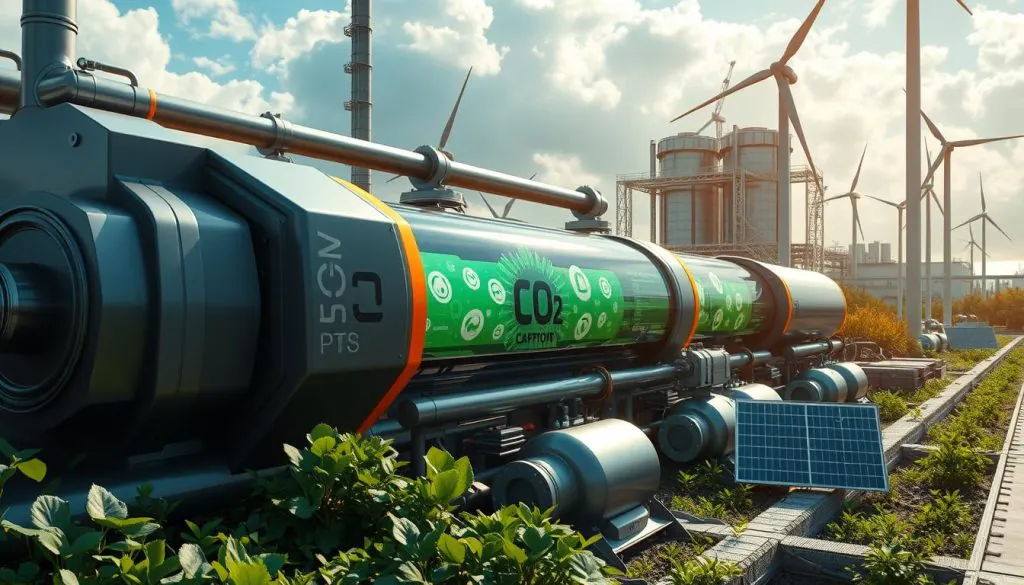
Industries face the challenge of reducing greenhouse gas emissions. They are adopting innovative strategies to produce cleaner products. carbon capture and storage (CCS) and the use of green hydrogen are essential in this process.
The implementation of CCS in the cement, steel and chemical industries is crucial to achieving carbon neutrality.This technology captures CO2 and stores it safely. This prevents CO2 from contributing to global warming.
Carbon capture and storage (CCS) technologies
The technologies of CCS are effective in decarbonizing heavy industrial production. They are essential for sectors that struggle to reduce emissions, such as cement and steel. The application of CCS improves the environmental profile of these industries, increasing their competitiveness in the market.
Green hydrogen and its industrial application
THE green hydrogen is a promising alternative for the industrial energy matrix. It replaces fossil fuels with a carbon-free option. Its production comes from renewable sources, reinforcing bioeconomy and sustainability.
Initiatives that combine CCS with the green hydrogen demonstrate Brazil's commitment to a low-carbon economy. These efforts follow global guidelines for combating climate change. They highlight the country as a key player in the search for innovative solutions for a sustainable future.
Low Carbon Economy as a Vector of Social and Economic Development
The world faces the challenges of climate change. A low-carbon economy is a necessary response. It is also a powerful tool for social development and economic. In Brazil, this change is a chance to create green jobs.
Implementing sustainable technologies in sectors like energy and transportation is a huge help. It not only reduces greenhouse gas emissions, but also creates new job opportunities, fostering a more just society.
Sustainability also encourages innovation. This requires new skills and knowledge. This leads to educational reform focused on the green economy.
This shift prepares current and future generations for environmental challenges. It also prepares them for economic challenges.
The adoption of a low-carbon economic model is essential for the social justiceIt creates a cleaner, healthier environment. It reduces inequalities and promotes equitable access to resources and opportunities.
The low-carbon economy is a valuable path for Brazil. It helps achieve the goals of sustainable development. And builds a more just and prosperous society.
Engagement of Companies and Investors in Low Carbon Projects
To the civil society organizations and investors are very engaged. They are focused on sustainable financing and green investmentsThis shows that people are more aware of the importance of taking care of the planet.
Participation of civil society organizations and green investments
To the civil society organizations are very important. They help mobilize the community and pressure companies and governments to be more sustainable. They also implement projects that demonstrate the value of sustainability.
Companies like Tegra Incorporadora are examples. They adopt ESG practices and demonstrate that investing in sustainability can be good for the planet and your wallet.
The impact of investment funds dedicated to sustainability
You investment funds Sustainability-focused investments are essential. They help direct money toward projects that benefit the environment and can also be profitable. Between 2013 and 2018, investment in climate change technologies grew by 42,00%.
Programs like the International Financial Corporation's are also important. They help build sustainable buildings and demonstrate the positive impact on financial of the construction sector.
Conclusion
To face the challenges of sustainable future, it is essential to adopt decarbonization measures globally. Research shows that investing in renewables can bring significant economic benefits. By 2050, this could increase global GDP and create jobs.
Studies indicate that renewable energy can create many jobs. The circular economy can also generate millions of new jobs. This shows that the transition to a low-carbon world is beneficial for the economy and employment.
International examples show the way to follow the Paris AgreementChile plans to use 70% of renewable energy. In Europe, switching from coal to gas and increasing carbon prices are important steps.
In Brazil, combating deforestation and the use of biofuels are essential. They demonstrate the importance of sustainable practices in business and agriculture.
The union between social and economic sectors is crucial to achieve the goals of Paris AgreementThis will help improve people's lives and protect the environment. The transition to a low-carbon world is a strategic path toward inclusive development.