
To the immigration policies are very important in today's world. Brazil, which receives many immigrants, is changing its laws. Law No. 13,445 brought major changes to protect the human rightsThis shows that Brazil wants to be more inclusive and humane.
Brazil is facing a major challenge with the increase in asylum applications. These numbers demonstrate the diversity and challenges faced by migrants. However, Brazil has faced criticism for limiting the entry of visa-free migrants. This violates refugee rights.
This recent change seeks to balance immigrant rights with the country's interests. migration policies in Brazil are always changing. They seek to meet the social and economic needs of the 21st century.
Today, Guarulhos International Airport is an important hub for many travelers. Many are waiting to learn if they can stay in Brazil. The name change, from "foreigner" to "migrant," shows that Brazil values the contributions of these individuals.
Historical Context of Immigration Policies in Brazil
Since the 19th century, Brazil has welcomed many immigrants. This has changed significantly over time. The country has undergone changes in the way it deals with immigrants.
First, there was the Foreigner Status, which protected the labor market. Then came the Migration Law, which values immigrants more as part of society.
From the Foreigner Law to the Migration Statute
Over time, immigrant laws in Brazil have changed a lot. Foreigner Status was focused on security and economic development. But with globalization, the need for fairer law arose.
Thus, the Migration Law was created. It seeks to give rights to immigrants and help them integrate into Brazil.
Immigrant Perception and Paradigm Shift
Previously, immigrants were seen as a threat. But that has changed over time. Today, we recognize their contributions to Brazil.
The new immigration law reflects this change. It views immigrants as individuals with rights, capable of helping the country.
Legislative Transformations and Adaptations
The changes in immigration policies were important. They were not only to meet external pressures, but also to adapt to Brazil's needs.
THE Migration Law replaced the Foreigner StatusIt aligns Brazilian laws with international standards and strengthens the rights of immigrants, valuing their contributions to society.
Current Immigration Legislation and its Impact on Human Rights
THE Migration Law (Law No. 13,445/2017) has changed a lot immigration policies of Brazil. She made the country follow international guidelines that value Human rightsThis law replaced a previous law that was more restrictive, focusing on the safety and economic benefits of immigrants.
Article 3 of the Migration Law establishes that rights are universal, indivisible, and interdependent. This means that the dignity of each person is the foundation of migration policiesThe Law also allows migrants to regularize their status even if they entered Brazil illegally, following the principle of humanitarian reception.
These changes demonstrate Brazil's desire for a more humane and inclusive approach. This contrasts with previous methods that included collective repatriations and deportations, which were contrary to international law.
The new legislation also expanded the types of temporary visas. Visas now include health treatment and family reunification, among others. These visas were previously managed by the National Migration Council. Furthermore, the Federal Public Defender's Office now defends the rights of migrants, strengthening their protection in Brazil.
With less than 1% of the population being foreigners and a low crime rate, these policies are essential. They ensure that migrants can live with dignity and safety. This legislative advancement demonstrates that Brazil is a welcoming nation that values the contributions of migrants and refugees to society.
The Role of the TCU in the Governance of Migration Policies
With the increase in migratory flows around the world, the Federal Court of Auditors (TCU) becomes very important. It monitors and regulates the migration policiesThis ensures the security of Brazil's borders and compliance with international laws. human rights.
This function is essential for efficient and transparent public administration, crucial in the current migration landscape.
Audit and Assessment of Borders
THE TCU makes a detailed audit of the border security. They analyze operations and entry protocols into the country. This oversight helps identify and correct any vulnerabilities that could threaten territorial integrity or national security.
THE TCU also monitors whether the initiatives implemented are working well. They ensure that public resources are used fairly and effectively.
Migration Flow Management and National Security
The TCU has an important role in creating migration policiesThey help respond to population movements. With more displaced people and international migrants, it is crucial to have governance that balances reception and security.
Through reports and recommendations, the TCU helps develop strategies. These strategies strengthen national security without neglecting people's fundamental rights.
Thus, the TCU's work not only improves Brazil's border security. It also demonstrates the country's ability to manage migratory waves in a humane and efficient manner. This reaffirms its commitment to dignity and human rights. human rights in migration policies.
Strategic Vision: The National Immigration Plan Post-European Crisis
With the migration crisis in Europe, Brazil needs to create a national immigration plan effective. This plan must welcome refugees with dignity and integrate them into society. The European experience points to important paths for our plan.
Since the Lisbon Treaty, Europe has been changing its immigration laws. The "European Blue Card" is an example of how to attract talent. national immigration plan Brazilians can follow these steps to attract and retain talent.
THE migration crisis in Europe demonstrates the need for stronger policies. The European Pact on Immigration and Asylum is one example. Brazil can improve its laws to address migration.
Studying what happened in Europe is important. Brazil can learn from these experiences to create a better plan. This way, the country will be prepared to deal with migration fairly and with a forward-looking perspective.
Types of Visas and their Implications for Brazilian Society
Brazil's immigration policy has several types of visasThey are used for tourism, business, and study. This variety helps facilitate entry and exit from the country. It also improves diplomatic and cultural relations through bilateral agreements and reciprocity policy.
Reciprocity Policy and Bilateral Agreements
Brazil has bilateral agreements with about 90 countries. This allows Brazilians and citizens of those countries to travel without visas. reciprocity policy It increases economic and cultural interaction. We attract tourists, investors, and academics who love Brazil.
Economic and Cultural Implications of Visas
Different types of visas have a major impact on Brazil's economy. Tourism and business visas bring international visitors and events. This helps local businesses and creates jobs.
Culture and education also benefit. Student visas and cultural exchanges promote the exchange of knowledge. This makes Brazil a hub of cultural and intellectual diversity.
The New Migration Law and the Challenges of Integration
THE New Migration Law was approved on May 24, 2017. It replaced the Foreigner Status 1980. This change brought a new way of seeing migration in Brazil.
With the law, the human rights of immigrants gained greater attention. It seeks to integrate immigrants into Brazilian society with dignity and equality. This represents a significant advance over the previous vision of national security.
A major change is the way we view immigrants. They are now seen as part of Brazilian society. This applies to both those who arrive and those who return to Brazil after living abroad.
The law also emphasizes the importance of public policies for immigrants. These policies must guarantee access to social services and equal opportunities.
Despite progress, integration still faces challenges. Many places lack infrastructure or services for immigrants. A lack of information and training for staff is also a problem.
To improve the situation, more shelters and language courses must be created. It's also important to expand services like the CRAS (National Social Assistance Center). Cooperation between government and civil society is essential for effective integration.
In conclusion, the New Migration Law is a major step for Brazil. It places human rights and dignity at the center of migration policies. But overcoming these challenges requires efforts from all sectors of society.
Immigration Policies
THE Law No. 13,445/2017 and the Decree No. 9,199/2017 Immigration rules in Brazil have changed. These changes were made to make policies more humane. They replaced old laws, enacted during the dictatorship.
These laws aim to make migrants more welcoming. They aim to be kinder and less harsh toward them.
Controversies and Innovations of Law No. 13,445/2017
The law introduced important innovations. It granted migrants more rights, such as healthcare and education. It also emphasizes cultural integration and civic participation.
However, the law has generated debate. Practical implementation faces challenges. Lack of resources and training are among the problems.
Analysis of Decree No. 9,199/2017
THE Decree No. 9,199/2017 detailed how migrants can enter and settle in Brazil. He also defined the types of visasThis helps to better manage the flow of migrants.
But there's still much to be done. Slow implementation and lack of uniformity are major obstacles.
Despite the challenges, Brazil is proving to be welcoming. Society values diversity and the contributions of migrants. This points to a new direction for migration policies.
Current Trends in Migration and Social Reactions
To the migratory trends Recent data show a staggering increase. The volume of migrant remittances grew from $128 billion to $831 billion between 2000 and 2022. This demonstrates the growth of migrants, who now number 281 million worldwide.
These figures highlight the economic importance of migrants to their countries of origin. They are especially important for developing countries. These countries received $647 billion in remittances, more than foreign direct investment in many cases.
To the social reactions to immigration vary greatly, depending on several factors. In South America, for example, international migrants account for 2.6% of the population. This represents an increase of almost 1% since 2015.
Problems such as poverty, hunger, and political instability drive migration. This generates various social and political reactions. Some favor restrictive policies, while others advocate for a more inclusive approach.
In Brazil, there is a debate about residency programs for Venezuelan migrants. This highlights the duality of perspectives. Successful integration of these individuals can bring significant economic benefits.
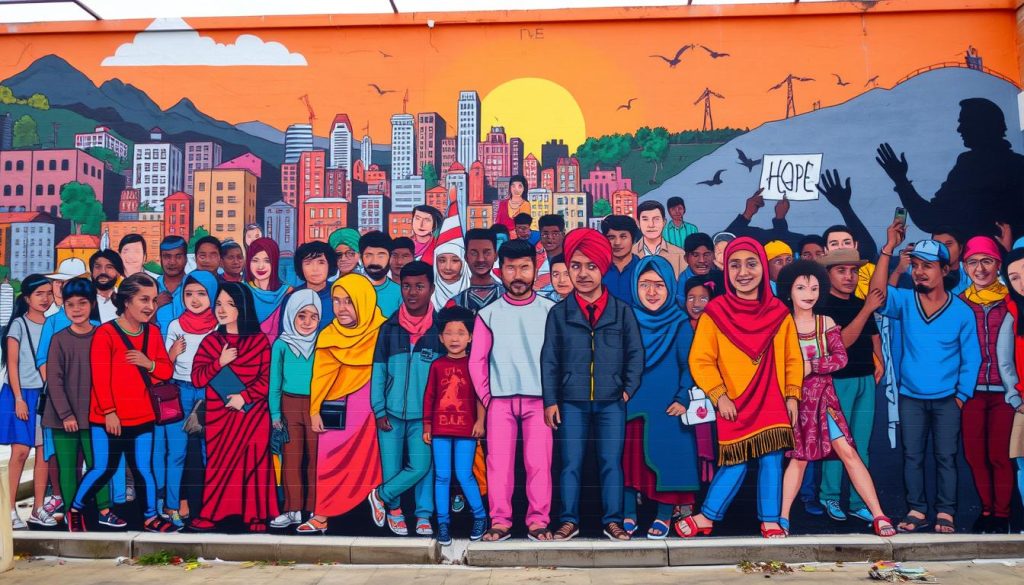
Brazil is an important example in the global debate on migration. Its policies are observed and discussed worldwide. This challenges policymakers to create more inclusive environments for migrants.
The Refugee Issue in Brazil and the Surrounding Bureaucracy
Brazil faces challenges with the right to refuge. This includes bureaucracy and human trafficking. In recent years, the number of refugees in the country grew by 39% between 2018 and 2019. This shows the need for changes in international refugee legislation.
Many migrants come to Brazil, especially from Venezuela, Haiti, and Cuba. The country seeks to integrate these individuals into society. However, slow and complex bureaucracy is a major obstacle.
The Right to Refuge and International Law
Brazil follows the international refugee legislationHowever, practical implementation faces many challenges. Non-governmental organizations and initiatives help refugees. They raise awareness and push for changes in bureaucracy.
The Situation of Airports and Human Trafficking
Airports, such as Guarulhos, are key points in combating human traffickingMore effective measures are needed. This highlights the importance of improving safety and professional training.
80% of refugees in Brazil are between 18 and 59 years old. More than 50% of them work. They have great potential to contribute to the economy. However, legal and structural challenges still prevent them from fully utilizing their potential.
Dialogue between international organizations, the Brazilian government, and human rights organizations is essential. They must work together to reform processes. This way, we can have a faster and more humane response to asylum in Brazil.
Logistical and Administrative Challenges of Mass Immigration
THE mass immigration brings challenges to any country. In Brazil, it is even greater due to the need to create public policies for immigrants effective. These policies should help integrate immigrants and resolve bureaucratic issues.
Operations like Operation Welcome are essential for receiving and integrating Venezuelans in several states. They demonstrate the logistical challenges we face.
Organizations like the International Humanitarian Federation (IFHF) and the Humanitarian Logistics Task Force (FT Log Hum – RR) are crucial. They strive for efficient and humane logistics management. Their work extends beyond reception in Roraima, preparing immigrants for life elsewhere in Brazil.
Programs like Brazil's Consolidated Refugee Policy are important. They are the result of a partnership between the International Organization for Migration and the United Nations Development Programme (UNDP). These programs seek to create legal and operational foundations for immigration, respecting the dignity and rights of migrants.
The effectiveness of these actions depends on a detailed analysis of the social and economic impact of immigration. This helps make adjustments and improvements to policies. This dynamic demonstrates the importance of updating policies. public policies for immigrants constantly. It is necessary to adapt them to the migratory reality and the characteristics of Brazil.
Perspectives for the Future of Migration Policies in Brazil
As we move forward into the 21st century, the future of migration policies in Brazil seems more humane and inclusive. Brazil has always shifted between restrictions and welcoming immigrants. The 2017 Migration Law marks a positive shift, viewing immigrants as rights holders and taxpayers.
International Cooperation and Development of Inclusive Policies
For the success of migration policies, it is essential to international cooperation and inclusive policies. Using multilateral agreements can strengthen support for migrants. international cooperation is crucial to addressing global migration crises.
Impact of Migration Policies on Society and the Economy
Migration policies have a significant impact on the Brazilian economy and society. Immigrants diversify the culture and stimulate the economy with their skills. Inclusive policies can improve migrant integration, increasing their economic contributions.
Conclusion
In a fast-changing world, understanding the immigration policies is essential. In Brazil, these policies seek a balance. They aim to protect human rights and help the country grow.
Today, more people are moving than ever before. In 1990, there were 80 million. Now, there are about 214 million. This shows how migration movements have changed.
Brazil's laws try to help people integrate. They also control who enters the country. This is important for Brazil's future.
Recently, many Venezuelans and Haitians have arrived in Brazil. This has changed the country's demographics. Therefore, policies need to be updated to help these people adapt.
While other countries struggle with immigration, Brazil is following its own path. Political decisions aim to help everyone, migrants and Brazilians alike. This demonstrates the importance of a analysis of immigration policies careful.