Brazil is an ideal place for foreign investmentIt has a vibrant market with many opportunities in various sectors. To help attract more foreign money, the "Legal Guide for Foreign Investors in Brazil" was created. This guide is a valuable aid for those looking to invest here.
In 2021, Brazil saw impressive growth in US$1.4 billion in Foreign Direct Investment (FDI)This demonstrates that the country is a standout in Latin America. Innovations in information technology, renewable energy, and the financial sector are strong attractions for investors from around the world.
Efficient tax policies and incentives are additional benefits. They are explained in detail in this essential guide for investors.
Brazilian law is robust and protects both domestic and foreign funds. With Resolution 4,373 of the National Monetary Council (CMN) and the CVM, Brazil allows foreign investors access to the same financial products as Brazilians. The Electronic Declaratory Registry (RDE) with the Central Bank ensures transparency and easy investment control.
So, this guide is essential for anyone looking to invest in Brazil. It helps you understand and invest safely and strategically.
Understanding the Brazilian Legal System for Investors
THE legal system in Brazil is essential for investment stability. It guarantees rights and protection for foreign capital. This contributes to economic growth and innovation.
Investing in Brazil can be very advantageous. But it's important to understand the legislation well. This helps maximize returns and reduce risks.
The Role of Laws and Institutions in Protecting Capital
Clear laws and strong institutions protect foreign capital. They ensure equal treatment for all investments. The Central Bank and the Chamber of Foreign Trade are instrumental in this.
Rights and Duties of International Investors in Brazil
It is crucial to know the international investor rights in Brazil. They are protected against expropriation and have the right to profits and capital repatriation. The Brazilian legal system is transparent and adheres to deadlines.
Understand the legal system in Brazil increases the chances of success and ensures that operations are legal and effective.
Foreign Investment: General Aspects and Benefits
Brazil is a top destination for foreign investment. These investments are essential for economic development and stability. They help expand local businesses and boost the economy.
They generate jobs, transfer technologies, and increase competitiveness. This improves the quality and innovation of the industrial and service sectors.
To the advantages of foreign investment improve quality and innovation. Investments bring knowledge and new technologies. This improves the production and management of Brazilian companies.
Operations and products improve, making the economy more robust and diversified.
Advantages of Foreign Investment for the Local Economy
THE economic impact on Brazil is positive. Foreign investment creates jobs. This is fundamental for the labor market.
They generate new jobs, from direct to indirect jobs in related sectors.
Impact on Brazil's Economic and Social Development
Foreign investment also improves social development. It increases educational and training opportunities. This benefits Brazilian workers.
The presence of large international companies brings valuable cultural exchange. This creates a more inclusive and diverse work environment. It promotes a more fair, balanced, and innovative society.
Attracting foreign investment is essential for the country's sustainable growth. It drives economic development and promotes social advancement.
The Brazilian Exchange Rate Regime and its Influence on Investments
THE Brazilian exchange rate regime is very important for the country's economy. It directly affects foreign investment. Since 1999, Brazil has used a floating exchange rate system. This means that rates are decided by the market, not the government.
The Central Bank can help keep interest rates stable. This flexibility helps maintain a balanced economy. It also attracts international investors.
With a floating exchange rate, Brazil lets the market decide the real's value. This is important for foreign investment. For example, if the real falls, investments in Brazil become cheaper.
This can attract more capital to the country. Exchange rate stability is essential for long-term investors. Economic uncertainty can affect the exchange rate.
The Central Bank monitors these uncertainties. They use the purchase or sale of foreign currency to control the exchange rate. This helps maintain a stable investment environment.
In 2020, the Central Bank injected over US$15 billion into the market. This was done to stabilize the real during the COVID-19 pandemic. These actions are essential to attracting foreign investment.
The Central Bank also offers tools to monitor exchange rates. For example, the VET Ranking compares exchange rates between financial institutions. This provides transparency and important data for operating in the Brazilian financial market.
Understand the Brazilian exchange rate regime and your influence on foreign investment is crucial. Investors need to know how exchange rate policies affect the market. This helps them make informed decisions and trust the Brazilian market.
Mapping Forms of Association and Entry into the Brazilian Market
Investing in Brazil requires understanding the forms of association in the Brazilian market. The choice between joint-stock and limited companies It depends on several factors, including the size of the operation, tax issues, and future strategies.
To the joint stock companies are good for those who want to grow quickly. They allow them to attract more money from the capital markets. On the other hand, limited companies They are ideal for small and medium-sized investors. They are simple to manage and protect partners' assets.
Limited Liability Companies as Investment Vehicles
Public limited companies attract investors who want to invest heavily. They allow for greater capital mobility. limited companies are good for those who want more control and less risk.
Associative Options and Procedures for Company Registration
Registering a company is essential to getting started in Brazil. This involves choosing the type of association and registering with regulatory agencies. This step defines the company's rights and obligations, helping it achieve success in the domestic market.
Capital Market Regulation and Its Attractions
THE Brazilian capital market is very important for the country's economy. Securities and Exchange Commission (CVM) is the main regulator of this market. It works hard to improve laws, ensuring that investors are well protected.
Securities Market and Investor Protection
THE investor protection in Brazil is very strong. This is due to several laws that govern everything from the sale of investments to market oversight. Law No. 11,638/2007, for example, made financial information clearer. This helped maintain the integrity of the Brazilian capital market.
Regulatory Aspects and the CVM
THE Securities and Exchange Commission The Brazilian Securities and Exchange Commission (CVM) plays a crucial role. It oversees and regulates the market, creating rules that protect investors. It also encourages foreign investment. The changes made aim to attract more foreign investment, following global trends.
Understanding Brazil's Fiscal and Tax Structure
THE fiscal and tax structure Brazil's tax structure is complex. It includes federal, state, and municipal taxes, as well as social contributions. Understanding this structure is essential for investors, both domestic and international. This helps with financial management and tax planning.
You tax incentives in Brazil are important. They help maximize investment returns and reduce tax liabilities.
Taxes, Contributions and Tax Incentives for Investors
You tax incentives in Brazil They aim to attract and retain investment in strategic sectors. They can reduce the tax burden. Therefore, it is crucial to understand when and how these benefits can be used.
With Law 14,754 of December 2023, taxation on foreign investments was simplified. There is now a single tax rate of 15% on income from foreign financial investments. This eliminates the complexity of the previous progressive tax rates.
Financial Management and Tax Planning
Browse by fiscal and tax structure Brazil's economy requires sound tax planning and financial management. Investors should be aware of tax variability, which directly impacts the financial results of operations in the country.
The gross tax burden of 32,43% in 2017 shows the importance of understanding how to optimize resources. Taking advantage of tax incentives in Brazil can make a big difference in the success of your investments. An efficient strategy can be decisive, especially with new rules aimed at greater transparency and tax fairness.
Antitrust Legislation and Its Importance for the Market
THE antitrust legislation in Brazil is essential to maintain the competitiveness and integrity of the Brazilian marketLaw No. 12,529 of 2012 created a strong framework to prevent practices that restrict competition. This helps protect consumers.
The Administrative Council for Economic Defense (CADE) handles all of this. It ensures that mergers and acquisitions do not harm competition. Thus, Brazilian market remains dynamic and stimulating for innovations.
Follow the antitrust legislation in Brazil is vital for companies looking to grow in the country. Transparent business practices are essential for success. This helps the company stand out in a global world.
THE impact on the Brazilian market The implementation of antitrust law also increases the confidence of international investors. Clear and effective policies create a safe business environment. This attracts foreign investment, which is essential for Brazil's economic growth.
So, understand and follow the antitrust legislation in Brazil It's more than a legal obligation. It's a strategy to stand out in the global market.
Aspects of Labor Legislation and the Hiring of Foreigners
THE labor legislation in Brazil defines clear rules for the hiring foreign workersIt helps both employers and employees. It seeks a fair balance and good integration into the Brazilian labor market.
According to the rules, foreign companies can hire foreigners in Brazil. This can be done through temporary, technical, or permanent visas. Each type of visa depends on the role and employment relationship.
For permanent visas, it's necessary to invest R$600,000 per foreigner. This generates at least ten jobs for Brazilians. Thus, the foreigner contributes to the local economy.
Labor rights are protected, even for those working outside Brazil. Companies that send workers abroad must provide the same rights as in Brazil. After two years, these workers are entitled to paid vacation in Brazil.
To hire Brazilians abroad, foreign companies must have 5% of Brazilian capital. This strengthens economic ties between Brazil and international companies and promotes legal certainty and trust.
Finally, hiring foreigners follows rules that value labor rights. This creates a fair and equitable work environment.
The Brazilian Real Estate Market and Ownership by Foreign Investors
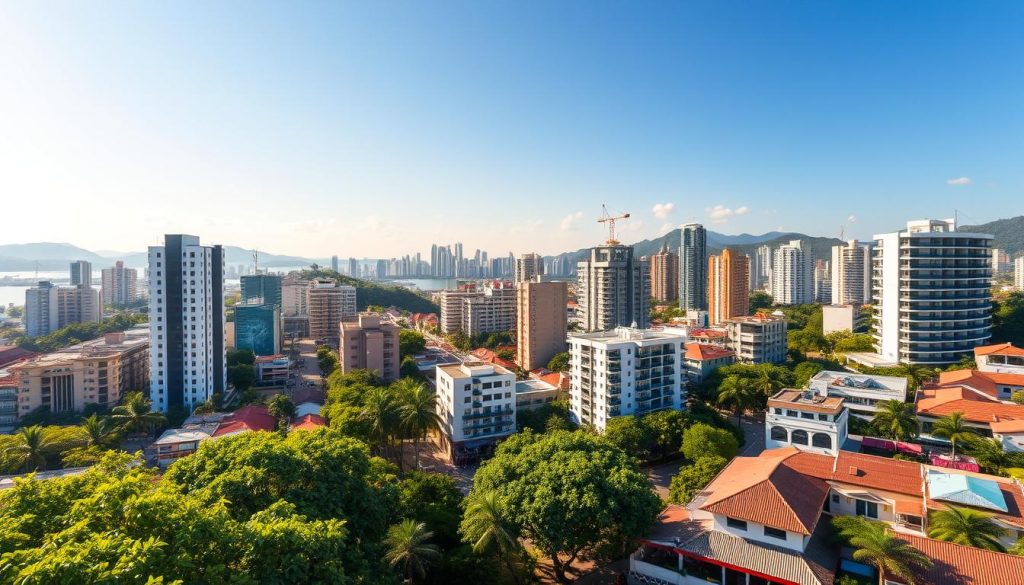
Node real estate market in Brazil, real estate purchases by foreigners are highly sought after. This is because there are many investment opportunities. Especially in the rural property sector, there are specific rules for those who do not live here.
According to Law No. 5,709/71, foreigners require permission to purchase rural land. Individuals can own up to 50 exploration modules, while companies can own up to 100 modules.
These modules can be purchased in a variety of ways. However, it's important not to exceed certain limits. For example, foreigners cannot own more than a quarter of a municipality's area.
Guidelines for Real Estate Acquisition and Real Estate Investment
Anyone wishing to purchase property in Brazil must follow certain rules. This helps maintain national security. In sensitive areas, purchases require special approval.
Regulation of the Acquisition of Rural Property by Foreigners
In addition to the general rules, there are special conditions for purchasing rural land. For example, authorization from INCRA may be required in some cases. Even with restrictions, foreigners already own approximately 0.8% of rural land in Brazil.
Understanding these rules is essential for anyone working in real estate. This helps you better plan and take advantage of investment opportunities in Brazil.
Conclusion
THE foreign investment in Brazil has shown contrasts. In 2020, there was a drop of 35,40% with a loss of R$$24 billion. But in 2021, the country began to recover.
Despite a 23% increase in foreign investment, the total value was US$$46.4 billion. This is less than the Central Bank's expected US$$52 billion. The pandemic and economic uncertainty have severely impacted investment.
Foreign investment has a significant impact on Brazil. It opens new markets and brings valuable resources. However, we face challenges such as high inflation and the pandemic.
Furthermore, the energy crisis poses a major challenge. The country's infrastructure relies heavily on hydroelectric plants, which face supply problems.
Despite the challenges, Brazil has great potential. Foreign Direct Investment growth to US$1.4 trillion in 2022 demonstrates this. Brazil is the seventh most sought-after destination for foreigners in emerging markets.
It is crucial to follow the instructions of Resolution No. 278 of the Central Bank of Brazil. Striking a balance between attracting investment and addressing economic and social challenges is essential. This will help the country develop sustainably.