
To the tendencies indicate a cultural and economic shift away from excessive consumerism. It promotes more conscious and sustainable practices. Brazil, with its great diversity, this economy has great potential. A 2014 PwC study predicts impressive growth: from $15 billion to $335 billion by 2025.
Definition and Origins of the Collaborative Economy in Brazil
THE collaborative economy grew a lot in Brazil. She comes from a culture of sharing and teamwork. Indigenous communities and other community organizations have always relied on cooperation.
With the global economic crisis of 2008, the way we consume and produce changed. This gave rise to new ways of sharing economy node Brazil. Access is now valued more than ownership, bringing many collaborative initiatives to the country.
The historical and cultural basis of the collaborative economy
Brazilian culture has always valued the collective. Today, this helps companies succeed. collaborative economyFrom cars to spaces, shared practices are growing. They help save money and make better use of resources.
The rise of the collaborative economy with technology
THE technology was essential for the expansion of collaborative economy node Brazil. Online platforms and apps make it much easier sharingThey connect those who offer with those who need, without intermediaries. This has changed the economy and how people relate to each other.
Collaborative economy
THE collaborative economy is more than a trend. It changes how we consume and use resources. Based on resource sharing, challenges the idea that we should own everything. It proposes using assets intelligently and sustainably.
A survey by CNDL and SPC Brazil showed that 98% of Brazilians think it's good. They see advantages in collaborative economyThis shows that the country is moving towards more conscious consumption.
The benefits include saving money, reducing waste, and consuming less. 45% think they save money. 44% say they reduce waste. And 43% want to consume less.
Furthermore, 34% want to save natural resources. This shows the impact positive of collaborative economy in the sustainability.
Companies like Uber and Airbnb are thriving. They have changed the Brazilian and global economy. Uber has more than 22 million users in Brazil. Airbnb has more than 90 thousand daily rates in the country since 2012.
It's more than just carpooling or lodging. It encompasses a wide range of services and products. For example, the Clorent clothing subscription club lets you use multiple pieces for a fixed monthly price. This eliminates the need to constantly buy and renew clothes.
The outlook for the collaborative economy is promising. By 2025, this sector could generate more than US$1.4 billion globally. In Brazil, it is essential for financial inclusion, economic diversity, and sustainability environmental.
Technology as a Catalyst for the Collaborative Economy
Nowadays, the technology is a great driver for the collaborative economyIt not only changes the way we do business, but also how we relate to each other online.
To the digital platforms are very important in this process. They help share resources more cheaply. This allows many people to use services and products without needing them themselves. This is changing the market in many ways, from transportation to lodging.
Digital platforms and resource sharing
Platforms like Airbnb and Uber show the power of collaborative economyThey allow personal assets, such as apartments or cars, to be used more efficiently. This creates a sustainable business model that reduces waste.
Impact of Internet 2.0 on the collaborative economy
THE Internet 2.0 also played an important role. It facilitates direct interaction between consumers and suppliers, without intermediaries. This improves security and transparency in transactions. Thus, Internet 2.0 helps democratize access to services and products, bringing about social and economic changes.
Main Collaborative Business Models
In Brazil, the sharing economy has transformed many sectors. It has brought new opportunities and more sustainable ways of consuming. Uber and Airbnb are examples of how sharing resources can be beneficial for everyone.
The approach to sharing in different sectors
Companies that share resources improve efficiency. They also create stronger connections between people. This is evident in services like Uber and Airbnb.
Coworking and personal item rental platforms are also growing. They extend the lifespan of products and help the environment.
Success Stories: Uber and Airbnb in Brazil
Uber and Airbnb have changed society and the economy. In Brazil, Uber has improved urban mobility. It's more flexible and economical than traditional transportation.
Airbnb has changed the hospitality industry. It allows property owners to earn extra money and offers travelers cheaper, more authentic options than hotels.
Conscious Consumption and Sustainability
With increasing awareness of natural resources, the conscious consumption and the sustainability have become essential. This is especially true in collaborative economyEarth Overshoot Day shows that humanity consumes 74% more than can be regenerated annually. This is a warning sign for changes in consumption habits.
The younger generations are more aware. About 47% of them prefer to buy used products. And 55% sell secondhand items. This trend is supported by shopping platforms. collaborative economy, which promote reuse and reduce waste.
In Brazil, the multi-ownership system is growing. In 2021, the sector saw an increase of 17% compared to the previous year. This demonstrates a preference for shared ownership models.
Projects like Amazon Fun Parks in Santa Catarina are examples. They are architecturally and sustainably aligned with the needs of the consumer conscious.
This shift toward sustainable practices is evident. Institutions like the Amazonizar Institute work to raise awareness about environmental issues. They use research and art to engage with the UN's Sustainable Development Goals.
These practices are becoming more common. This shows that we are moving towards a more sustainable world. collaborative economy is essential in this process, offering platforms and opportunities for changes in consumption patterns.
Changes in the Work Environment and Collaborative Management
The collaborative economy has brought great changes to the work environment. Now we see more flexibility, like the home office. This shows a new focus on mental health and well-being of workers. This change is essential for a collaborative management effective, which values autonomy and job satisfaction.
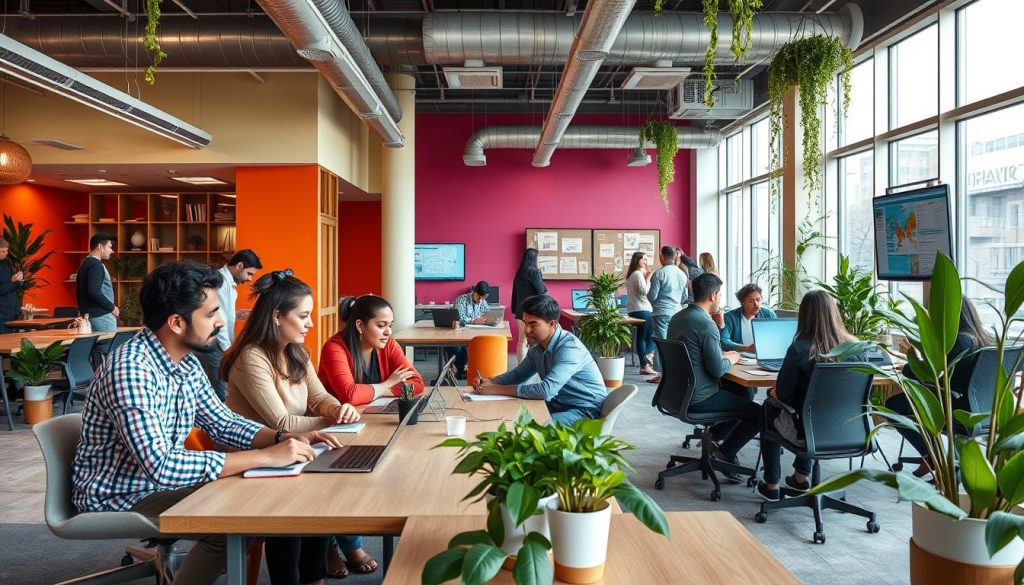
From home office to new organizational dynamics
THE home office helps balance personal and professional life. This is crucial for mental health of employees. Flexibility is not only a benefit, but also a new way of working that improves productivity and motivation.
Influence on mental health and productivity
THE mental health is a key point in human resources policies. The collaborative management creates an open, less hierarchical environment. This improves employee well-being and increases productivity. Workplaces are now spaces for growth and emotional support.
Innovations Generated by the Collaborative Economy
THE collaborative economy is a powerful force of innovationsIt's changing markets, societies, and businesses. Companies are tapping into previously untapped resources. This is creating profitable and sustainable opportunities.
Examples of the sharing economy are growing rapidly, demonstrating that companies are adapting well to new market demands.
In Brazil, the business environment is changing. Business models that share resources are emerging, ranging from shared cars to shared workspaces. Investment in these ideas is growing significantly.
To the innovations from the collaborative economy have a great impactThey go beyond commerce, improving society. For example, apps like Uber are changing urban mobility. Platforms like Airbnb are revolutionizing the hospitality industry.
These companies, without many physical assets, are generating large profits. They are changing how we consume things through sharing.
The adoption of these practices in Brazil is transforming companies. It's creating a culture of cooperation and innovation. Companies are adopting hybrid work systems and shared factories.
These innovations demonstrate the importance of the collaborative economy. It is renewing the economy and society in Brazil. With continued growth, we will see more innovations disruptive. They can change business success in the country and around the world.
Social Impacts of the Collaborative Economy
You social impacts from the collaborative economy have significantly changed the world's societies and economies. They connect people from different places, helping to overcome economic barriers. This improves social inclusion, both in large cities and in more isolated places.
Previously, access to basic services and economic opportunities was difficult. Now, thanks to the sharing economy, that has changed.
Social power in collaborative networks
To the collaborative networks They give a voice to small entrepreneurs and consumers. They can significantly change the market and society. Platforms like Uber and Airbnb have transformed the transportation and hospitality sectors.
They've created new ways of interacting socially and economically. Now, anyone can transform their resources into income opportunities. This democratizes market access.
Global transformations and local impacts
To the global transformations from the collaborative economy have incredible local impacts. They revitalize small communities and reduce the carbon footprint of large cities. Adopting sustainable practices on collaborative platforms improves the environment.
This encourages people to be more conscious and responsible. Thus, the collaborative economy model improves social and economic life in many ways.
This economic model connects people, facilitates access to resources, and better distributes income. This demonstrates the power of the collaborative economy model in today's world.
The Role of the Consumer in the Collaborative Economy
The sharing economy has changed how we buy and sell. It has brought change of mentalities and new forms of consumption. The consumer is essential to the success of this economy.
Today, the consumer He doesn't just buy. He can also sell, influence, and create. This shows that value isn't just about owning something, but also about using and experiencing it.
Changing mentalities and consumption patterns
In Brazil, 89% of consumers like the sharing economy. This shows that people are changing how they shop. They value sustainability and community interaction.
The perception of value in exchanges and use of services
People are changing how they view value. Services like Airbnb are growing. They show that experiences and economic diversity matter. collaborative economy will reach US$1.4 trillion in revenue by 2025.
So, the change brought about by the collaborative economy isn't just technological. It's a profound shift in consumers. They're creating a new market with more conscious and collective choices.
Conclusion
The collaborative economy is essential for Brazil's growth. Companies like Forbes reported that revenues had already reached US$15 billion in 2015. PwC predicts that revenues could exceed US$150 billion by 2025.
Brazil leads Latin America in the collaborative economy, with 32% of these initiatives. This demonstrates an environment of innovation and a society open to new businesses. Startups like Airbnb and Uber are examples of this trend. Coworking spaces are also growing, fostering the exchange of experiences.
This economy has a great impact In Brazil, it can reach 30% of GDP in the services sector. It reduces costs and consumption, maintaining essential services for the population. Nielsen research shows the positive impact of collaborative consumption.