THE virtual reality in Brazil opens a new world for us. It makes the difference between the real and the virtual disappear. Year after year, this immersive technology improvement, bringing not only fun, but also changes in education and work.
Studies show that virtual reality is more prevalent in schools. It seeks to improve education. With it, teachers and students experience a new way of learning, without physical or time constraints.
The solutions in virtual reality in Brazil are becoming more accessible. They help various sectors change. With visual and interactive resources, virtual reality promises a immersive experience and dynamics on any topic.
The Emergence and Trajectory of Virtual Reality in Brazil
THE history of virtual reality in Brazil began with slow steps. But, with the advancement of technological evolution worldwide, the country stood out. From the first stereoscopic devices to modern headsets, there has been a huge change.
Beginning and First Steps in the Country
THE digital innovation in virtual reality began in the 19th century. In Brazil, it was only in recent decades that these technologies began to be widely used. Brazilian developers, inspired by Charles Wheatstone, created their own devices.
Technological Advances and Global Influence
Advances like the Oculus Rift have changed the history of VR in Brazil. Brands like Sony and HTC have introduced new technologies. They have enabled medical simulations and immersive experiences in games and education, opening a new era.
The Technology Behind the Immersive Experience
THE advanced VR technology is essential for the immersive experience. It allows people to feel part of the digital environmentVirtual reality headsets are largely responsible for this.
These headsets feature high-resolution screens and special lenses. They capture the user's movement in real time. This adjusts the virtual environment to create a sense of presence.
Specialized software is essential for creating these virtual environments. It models detailed scenarios and allows for natural interactions. This makes immersive experience more realistic and interactive.
Advances in VR technology are constantly growing. It's used in education, healthcare, industry, and entertainment. advanced VR technology goes beyond games and leisure.
They allow us to safely simulate complex environments. This helps professionals practice their skills safely. Virtual reality promises to expand our experiences, allowing us to explore new worlds.
The Role of Virtual Reality Headsets
You VR headsets are essential in the evolution of virtual reality technologyThey create a unique experience, transporting users to new worlds without leaving home. There are many models, each with its own features and technologies.
Various Models and Accessibility
The market offers VR headsets For everyone, from the budget to the expensive. You can find everything from Google Cardboard to Oculus Rift. This allows more people to experience virtual reality, whether they're looking for money or a desire for adventure.
Major companies like Sony, Microsoft, and Meta are constantly improving these devices. They want to make virtual reality more accessible and effective.
Impact on Immersion Quality
The quality of immersion depends heavily on the equipment. Headsets with fast screens and precise controls, like the HTC Vive, offer a better experience. These features are important for interacting with the virtual environment.
When users can move and act naturally in the virtual environment, virtual reality reaches its peak. This opens up new possibilities in virtual reality technology.
Augmented Reality vs. Mixed Reality: Understanding the Differences
To the digital technologies are advancing rapidly. Two innovations that attract attention are the augmented reality (RA) and the mixed reality (RM). They change how we interact with the digital world. Knowing the differences helps us use each technology better.
THE augmented reality It puts virtual information into the real world. You can see how a piece of furniture would look in your home before you buy it. Companies like IKEA use this to make purchasing more interactive.
THE mixed reality combines AR and virtual reality. It creates an environment where physical and digital objects interact. For example, Microsoft's Hololens headset does this incredibly well.
THE augmented reality can be used on common mobile devices. mixed reality requires more advanced equipment. This makes MRI more expensive and difficult to access.
These digital technologies They're not just for entertainment. They also change architecture and design. They allow us to see projects more realistically. Technology is increasing our interaction with the world.
Technical Aspects: How Virtual Reality Works
Exploring virtual reality (VR) is entering a world where motion tracking and interactivity are key. This technology creates immersive experiences and convincing. It uses advanced software to allow users to interact naturally with virtual environments.
The principle of VR is simple. Virtual reality software captures users' movements and transforms these movements into actions in the digital world.
Motion Tracking and Interactivity
THE motion tracking is the heart of virtual reality. It allows the system to see every user action. This includes head orientation and hand positioning.
Technologies such as gyroscopes and motion sensors make this connection. They synchronize physical movements with the virtual environment. This creates an immediate response, increasing the sense of presence.
That interactivity is essential. It allows users to manipulate objects or change the environment naturally.
Software that Creates Worlds
THE virtual reality software is the great architect of experiences. He builds detailed scenarios, from flight simulations to recreations of historical events. These programs define the rules of the virtual world.
They also determine the environment's textures and how elements interact. Furthermore, the software manages inputs and variables to keep the system stable. This includes adjusting lights, shadows, and special effects.
Transformative Applications of Virtual Reality
Virtual reality (VR) is changing many areas, such as education and healthcare. With VR applications, these changes are possible, accessible and innovative. The virtual reality in education creates immersive environments for students. They have hands-on experiences without the real-world risks.
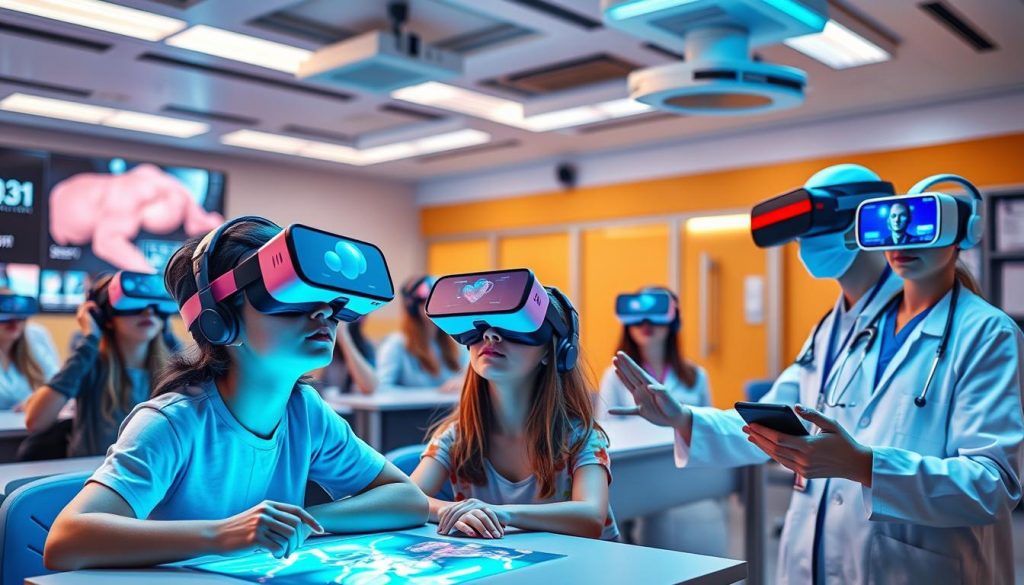
In the digital health, VR goes beyond expectations. It greatly aids surgical training, patient rehabilitation, and preparation for complex procedures. This technology improves the efficiency, accuracy, and safety of healthcare professionals. It uses VR applications dynamically.
VR in Education and Professionalization
Classroom simulations and virtual training are impactful in virtual reality in educationStudents from various disciplines explore famous landmarks without leaving their classrooms. This enriches knowledge and deeply engages students.
Immersive Experiences in Health
VR has changed the digital health, especially in surgical training. Resident doctors practice in a safe environment. VR also helps with rehabilitation therapies, offering simulations that aid recovery in unprecedented ways.
Virtual Reality and Its Impact on Brazilian Entertainment
In Brazil, the virtual reality is changing the digital entertainment. It is present in cinemas and streaming platforms. This technology brings immersive experiences that make the content more engaging.
Major franchises are using virtual reality, demonstrating its significant potential to transform cultural industries. With special headsets, users can experience adventures in a new way.
Virtual reality is allowing people to interact with content in different ways, from games to virtual tours of famous landmarks. digital entertainment in Brazil is evolving, blurring the boundaries between the real and the virtual. Thus, virtual reality not only improves the user experience but also redefines entertainment.
The Integration of Virtual Reality with Other Technologies
THE technological integration is changing many industries. It combines virtual reality (VR) with technologies such as augmented reality (AR) and artificial intelligence (AI). This creates new solutions that go beyond what we knew before.
This union is growing rapidly. It promises to change how we interact with the digital and physical world.
The Magic of Augmented Reality in Education
In education, the augmented reality in education is very important. It can add digital information to the real world. This makes learning more dynamic and interactive.
With AR, students can view complex illustrations and simulations in their textbooks or mobile devices. This helps them understand difficult topics in a more accessible and interactive way.
The Hybrid Future: VR and Artificial Intelligence
The union of VR and AI defines the future of technological interactions. AI makes virtual reality environments more reactive and adaptive. They change in real time according to the user's actions.
That interactivity Personalized design greatly improves the user experience. It also opens doors to immersive training, learning, and entertainment.
Challenges and Limitations of Virtual Reality in Brazil
Despite great advances in evolution of virtual reality, Brazil faces VR challenges important. The main technological limitations include the need for improvements in image quality. It's also essential to increase device comfort for a better immersive experience.
Another major hurdle is creating more natural and intuitive interactions. Many VR devices still have interfaces that don't integrate well with human movement. This can diminish the sense of immersion. It's crucial that VR technology in Brazil improves to be more ergonomic and user-friendly.
Education and healthcare offer great potential for virtual reality. However, the costs of implementing VR and AR labs are high. Furthermore, creating appropriate educational content is a challenge. Investing in accessible technologies and training educators is essential for progress.
VR development in Brazil is promising. However, an integrated approach is needed. This includes improving technology, reducing costs, and educating users and developers. This will help overcome the challenges. technological limitations and move forward with the evolution of virtual reality.
Conclusion
This article showed how virtual reality is growing in Brazil. It's used in entertainment, training, education, and more. future of virtual reality depends a lot on technological advancement.
This technology creates unique experiences. This helps a lot in digital transformation in various sectors.
Statistics show rapid growth in virtual reality. It's used in pilot training and medical simulations. In sports, Zwift demonstrates that immersive training is changing the game.
Despite its challenges, virtual reality is a field brimming with innovation. It's crucial for education, helping develop important skills and learning in virtual environments.
The implications for students and professionals are significant. It prepares society for a more technological world. Even with challenges, virtual reality promises an unprecedented future of learning and professional development.