
To the neural networks changed the game in artificial intelligence. They make machines learn and act in incredible ways. In Brazil, these networks are essential to boost the technological innovation in various areas of the economy.
They're like the human brain, but in technology. They process and understand information in complex ways.
To the neural networks have millions of 'artificial neurons'. They are in layers that communicate with each other, making the networks act with agility and precision. They are in factories and even in medical diagnostics in Brazil.
There are several types of neural networks, each for specific tasks. We have Perceptron, Feedforward, CNNs, and Recurrent. The CNN AlexNet was a milestone, demonstrating the power of networks in image processing.
Node Brazil, to the neural networks are more than tools. They are essential for making important decisions. They unite the machine learning with human experience, creating a balance between data and social understanding.
Introduction to Neural Networks
To the neural networks are inspired by human nervous system. They are a great advance in machine learningThese systems mimic the work of human neurons, helping with many tasks.
They use advanced data and algorithms. neural networks are essential to many new technologies. They analyze large amounts of data and learn on their own, improving their tasks.
Node Brazil, the use of neural networks is growing. They are used in areas such as finance and healthcare. Brazilian companies have greatly improved with these technologies.
To the neural networks are more than technology. They change the world of data processing and the artificial intelligenceThey are making a big difference in Brazil and the world.
The functioning of Neural Networks and Information Processing
Neural networks are a major breakthrough in artificial intelligence. They use deep learning and mimic the human brain. artificial neurons are the base, activated by neural stimulation. They pass data through synapses simplified.
Modeling Artificial Neurons
A neural network begins with the creation of human neurons. They process data through neurons that mimic the capabilities of a biological neuron. These artificial neurons connect by synapses, dealing with a lot of information.
Activation Mechanism and Weights
THE activation mechanism is essential for neural networks. The sum of the data entries is weighted by synaptic weightsThis decides whether a neuron will be activated or not. Adjusting these weights during training improves the network's accuracy.
Deep Learning Architectures
The complex tasks that neural networks perform today are made possible by hidden layers of deep learningThese layers increase the depth of processing. They enable everything from pattern recognition in images to advanced predictive analytics.
The Neural Network Revolution in Industry 4.0
THE Industry 4.0 is ahead with the help of Artificial intelligence (AI) and neural networks. These technologies greatly improve the business efficiencyThey not only automate, but also optimize processes through constant learning.
Neural networks have changed a lot Industry 4.0They help in many areas, such as quality control and predictive maintenance. They allow companies to quickly perform complex analyses, helping them make quick and accurate decisions in a competitive market.
Neural networks also help customize production. They allow operations to be adjusted to meet customer needs without interrupting production. This improves customer satisfaction and resource management.
Adopting neural networks greatly improves the business efficiencyThey deploy AI systems that learn and grow. This ensures a lasting competitive advantage in Industry 4.0.
Core Components of Artificial Neural Networks
Understanding the structure of artificial neural networks (ANNs) is essential to appreciate their ability to perform complex tasks. These range from pattern recognition to real-time decision-making. Networks have multiple layers, each with a crucial role in data processing.
Input, Hidden, and Output Layers
The data journey begins at input layer. Here, the initial signals are received. Then, this information is sent to the hidden layers, the heart of the network.
In these layers, most of the weight calculation and adjustment occurs. These adjustments are essential for transforming and understanding the data. Ultimately, output layer summarizes and returns the final results processing, ready for use or interpretation.
Activation Functions and Results
To the activation functions are essential for the performance of ANNs. They determine whether a neuron should be activated or not, based on the relevance of the neural signal received. These functions introduce nonlinearities that are vital for learning complexities in the data.
They allow the network to make more effective generalizations and exhibit adaptive responses. Thus, activation functions have a direct and powerful influence on final results processed by hidden layers.
Understanding the layered organization of ANNs and the role of activation functions is crucial. This helps us appreciate how these artificial intelligence tools operate and adapt to diverse applications. They revolutionize fields such as medicine and financial engineering.
Practical Applications of Neural Networks in Brazil
In the era of digital transformation, the artificial intelligence in Brazil is essential. It uses neural networks to change industries and improve processes. In industrial automation, for example, they make factories more precise and efficient.
THE predictive analysis is an impressive area of AI. It uses neural networks to predict failures and improve maintenance. This helps prevent unexpected downtime, keeping production flowing.
Neural networks also help understand consumer behavior. Companies use these technologies to personalize services and products. This improves the user experience and increases sales.
Thus, the use of neural networks in Brazil is growing. They range from industrial automation to digital marketing strategies. The artificial intelligence is a pillar for the technological innovation in the country.
Neural Networks: From Machine Learning to Deep Learning
The evolution of neural networks has greatly changed artificial intelligence. It has gone from data modeling simple to deep learning complex. In Brazil, this has changed how we process and understand data.
Relationships between Data Inputs and Outputs
Neural networks learn from data without requiring specific programming. They're excellent at predicting events and finding patterns in large amounts of data. This is very useful in business and science.
Pattern Prediction and Identification
The systems of deep learning take data analysis to a new level. They better handle data complexity. In Brazil, this can provide a competitive advantage in several sectors.
Understanding and using these systems can lead to major advances. This applies to areas such as finance and public health. It demonstrates the potential of deep learning in the country.
Types of Neural Networks and Their Specificities
Exploring the universe of neural networks, we see that each type has its own unique characteristics. They are essential tools in various areas of technology and research. Perceptron until the Convolutional Networks and Recurrent Networks, the advances are impressive.
Perceptron: The Pioneer of Neural Networks
THE Perceptron is the precursor to neural networks. It is a simple model, with one neuron that performs basic classifications. Its role was crucial to the development of theories of machine learning.
Feedforward Networks and Their Advances
To the Feedforward Networks are an evolution of PerceptronThey have multiple layers of neurons to process complex data. Each layer extracts different features from the data, aiding in tasks like pattern recognition.
Convolutional and Recurrent: Specialized Networks
To the Convolutional Networks and Recurrent Networks are very sophisticated. Convolutional machines are excellent for image analysis. They process visualizations as tensor matrices, with applications in medical diagnostics and autonomous security.
To the Recurrent Networks are excellent for data sequences. They are used in time series forecasting and natural language processing. Their structures allow them to 'learn' and adapt autonomously.
This diversity of neural networks and their constant improvements enable more effective solutions. They meet the demand for automation and intelligent systems that can learn and adapt on their own.
Technological Advances and their Impact on the Development of Neural Networks
Technological advances, especially in computational capacity, are essential for the development of artificial intelligence modelsNeural networks, which mimic the human brain, have become more sophisticated. This is due to technological advancement.
A major breakthrough was the improvement in computational capacityThis allows for rapid analysis of large volumes of data. This improvement is crucial for training deep neural networks, which require a large amount of data to learn and predict accurately.
More robust algorithms and complex architectures, such as recurrent and convolutional neural networks, are also the result of technology. They enable neural networks to perform human-like tasks, such as recognizing patterns in natural language and visual analysis.
The practical application of these technologies across various sectors has been a game-changer. From recommendation systems to autonomous robots, the influence of neural networks is profound. It demonstrates the impact of technological evolution in the computational capacity and us artificial intelligence models.
Comparison: Neural Networks and Human Intelligence
The debate between artificial vs. human intelligence is very interesting. The human learning demonstrates our ability to learn and create creatively. Neural networks, however, despite their advanced nature, still follow the rules they were programmed into.
Neural networks are based on the structure of the human brain. They were created to learn and process information like us. But even with advances in machine learning and Deep Learning, they are still very different from our neural networks.
These systems can learn from millions of examples. But they still can't match the complexity of human learning.
On the other hand, artificial intelligence has brought advances. In some tasks, machines can even outperform humans. But these tasks are very specific. Neural networks can't transfer these skills to different situations, as we can.
When we train deep networks, we fine-tune millions of parameters. This allows them to categorize images or understand language. But even so, they lack understanding or consciousness, important characteristics of human intelligence.
Neural networks are highly effective in fields like computer vision and natural language. However, human intelligence is much more flexible and adaptive. It can learn and reason in ways that machines cannot yet.
The discussions about artificial vs. human intelligence show how advanced we are. They remind us of the limitations of technology in replicating human cognition.
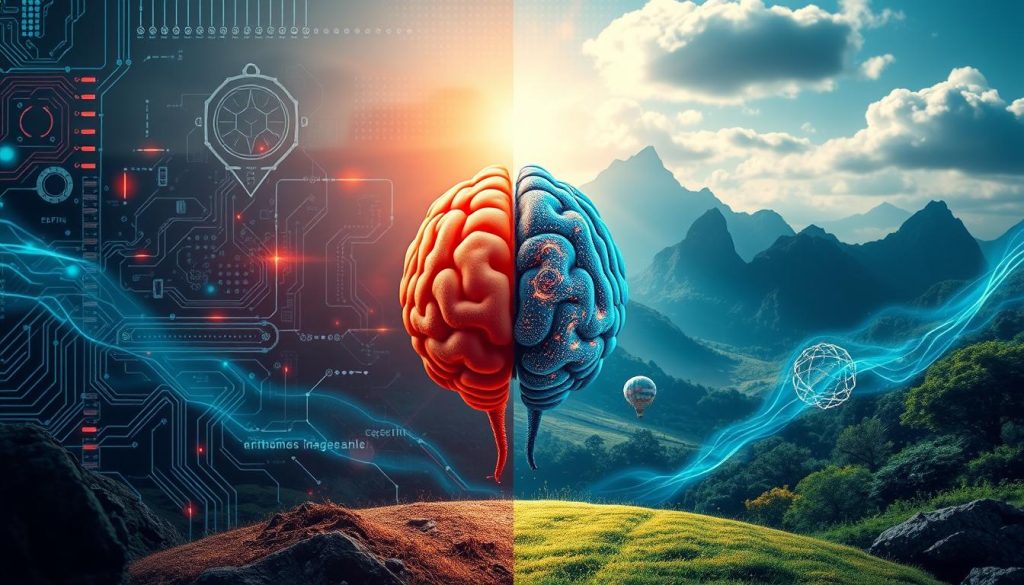
Technical Elements of Neural Network Construction
Understand the technical elements in AI construction is essential. This includes the processing units that are part of neural network models. The artificial neuron is the basic unit for processing. Knowing this helps to advance in artificial intelligence in Brazil.
The Anatomy of the Artificial Neuron
In neural networks, the artificial neuron mimics the biological neuron, but in a digital way. They are essential to perform mathematical operations basic. These operations, when combined, allow for complex tasks of statistical learning.
Each neuron receives multiple inputs, processes them, and passes the results to the network. This helps create AI models that can predict and adapt.
Mathematical and Statistical Operations in Learning
To the mathematical operations and the statistical learning are complex. Methods like backpropagation adjust the weights of neurons to improve predictions. These operations improve the capabilities of processing units.
They are crucial to creating AI models that can learn and adapt from data.
Conclusion
Neural networks represent a major technological breakthrough. They began in 1943 with Warren McCulloch and Walter Pitts. Today, they aid in image and natural language recognition.
They're used in many settings, such as autonomous driving. Here, they mimic the human brain, helping to solve complex problems efficiently.
Important algorithms, such as Perceptron Frank Rosenblatt's 1958 work helped a lot. And Kunihiko Fukushima's Neoconitron in 1980 was also crucial. Today, neural networks are as good as the human brain at some tasks.
Tools like TensorFlow and PyTorch demonstrate how technology is constantly improving. They're incredibly helpful in research and development.
For the future of AI, things look very promising. Quantum neural networks and new technologies like IoT and Edge Computing will change a lot. This will lead to more automation and innovation.
Machine learning systems are becoming increasingly autonomous. This makes us wonder how far technology can go. Neural networks are essential to human progress.
Therefore, it is crucial that these systems continue to evolve. They are fundamental to the future of modern society.