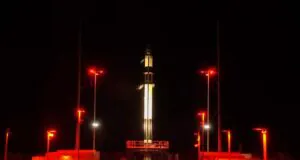
For 46 long days, Rocket Lab struggled with government paperwork, coastal airline flight restrictions, and, most importantly, Mother Nature, waiting for an opportune moment to conduct its first Electron rocket launch from the continental United States. From December 9th (when the rocket was supposed to launch) to January 24th (when it finally did), investors waited. But it was worth the wait.
When Electron finally launched last month, it was a resounding success. CEO Peter Beck had kind words for his team and others.
Mission 100% successful, congratulations to the Rocket Lab team, @NASA_Wallops @Virginia_Spazio @FAANews @hawkeye360. Looks like everything works in the northern hemisphere too.
Rocket Lab shares have also had a good run. After hovering around $1,000 per share for much of the holding period, the stock began a steady climb in the second half of January. As of Friday's close, Rocket Lab shares were up $3,100 since the start of trading on December 9.
Light this candle
What's the connection between Rocket Lab's fairly common rocket launch and Rocket Lab's extraordinary stock price performance? I mean, SpaceX is launching rockets at a rate of more than once a week these days. Really, it all comes down to that.
From its founding in 2006 to its first launch in 2017 and until November 2022, Rocket Lab USA was always a U.S.-only company. None of the company's previous 32 successful launches were from the United States, but rather from one of two launch sites in New Zealand. While U.S. customers account for about three-quarters of Rocket Lab's business, in late January, they had to ship their payloads halfway around the world before Rocket Lab could launch them.
It's not like that anymore.
On January 24th at 6:00 PM ET, Rocket Lab launched from Launch Complex-2 at the Mid-Atlantic Regional Spaceport in Wallops Island, Virginia, beginning a new phase of growth in its space company. By supplying three low-Earth orbit radio frequency geospatial analysis satellites to Virginia-based HawkEye 360, the company announced that it is now capable of launching payloads from American companies directly into orbit from those customers' backyards.
By expanding into Virginia, Rocket Lab has also increased its launchpad collection by 50%, to the point where, at least in theory, if it can find enough paying customers, Rocket Lab could launch up to 130 rockets per year. This theoretically puts it in a position to compete with SpaceX itself, which already plans to launch over 100 rockets this year.
What this means for investors
In reality, of course, Rocket Lab is still far from launching anywhere near 130 rockets, let alone 130 rockets per year. The company's most prolific year was 2022, and it launched only nine times—less than once a month, let alone twice a week.
According to analysts consulted by S&P Global Market Intelligence, Rocket Lab is still at least three years away from turning a profit. To break even, the company will likely need annual revenues of $1.5 billion to $1.5 billion, implying a launch rate of 30 or more missions per year, plus contributions from the company's rapidly growing space systems business (e.g., satellites, spacecraft parts, and space services).
What will it take for Rocket Lab to grow to this size, and possibly even faster than 2025? Building a larger rocket—the Neutron, 40 times larger than the Electron—will help the company win orders from major satellite manufacturers and owners of large satellite constellations. But having a spaceport located on the same continent as most of its customers could help even more.
Rocket Lab made a bold move by moving to Virginia. Rocket Lab investors should be paying close attention now to see if the move leads to more U.S. companies awarding Rocket Lab launch contracts.
Rich Smith holds positions at Rocket Lab USA. The Motley Fool has no position in any of the securities mentioned. The Motley Fool has a disclosure policy.