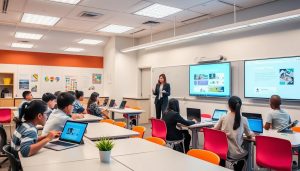
In a world where the technology in education is crucial, the hybrid teaching emerges as a powerful solution. Recent studies show that 551% of teachers in Brazil use technology regularly. in their classes. This highlights how the hybrid teaching is changing professional training.
Brazilian companies, such as MOVPLAN SE, are at the forefront of this change. They create technologies that facilitate this transition, such as Digital Whiteboards. These whiteboards come with QUADRIBOOK Educational Software. This allows for recording dynamic lessons packed with interactive features.
With the pandemic, the need to adapt to hybrid teaching has grown. Schools have begun using the MOVPLAN TouchPro Whiteboard. This device combines traditional and digital technologies. Furthermore, innovations like the Charge Mate Charging Cabinet aim to protect health. They ensure the cleanliness of electronic devices essential for today's learning.
Hybrid learning gains momentum with the National Education Council's guidelines. They now recommend the use of remote learning. They also allow for adjustments teaching methodologiesThe pandemic has made us realize that we need more flexible learning methods. According to the Unibanco Institute, this can reduce the damage to education caused by health crises.
The future of blended learning in Brazil is promising. The CNE strongly supports this idea, and ABMES is discussing its implementation. Given the challenges of modern education, blended learning proves essential. It's not just an alternative, but a crucial part of education in the country.
Introduction to Hybrid Learning and Its Impact on the Public Sector
Hybrid learning gained momentum in Brazil after the pandemic. It brought a new way of learning. educational transformation in the public sector. This method helps effectively train managers, saving resources and improving quality.
The creation of the National School of Public Administration (Enap) in 1986 aimed to raise the level of professional educationSince then, with the 1996 Guidelines and Bases Law, there has been a continuous effort to improve civil servant training. This law was crucial for standardizing education across municipalities and improving personnel management in the public sector.
The Evolution of Hybrid Education in the Brazilian Context
The need for more effective public services has led to the rise of hybrid learning. It combines traditional learning with new technologies, meeting the needs of administrators. The COVID-19 pandemic has accelerated the use of digital tools, transforming education.
Training and Professionalization of Public Managers
The news teaching methodologies changed the development of public administrators. Hybrid learning allowed them to continue studying, even during crises. This model not only saves money but also increases the quality of learning. It has become a vital tool for improving professional education in Brazil.
How blended learning is transforming professional development
The mixture of online teaching with face-to-face classes creates the blended learningThis method is changing how people learn for work. It combines flexibility with personalized lessons. Thus, courses at Instituto Mix de Profissões can be completed according to the student's schedule. They cover everything from nail extensions to barbering, meeting a variety of needs.
This model also gives students more control over their studies. They choose when and how to study. This is great for those who work and study at the same time, something quite common these days.
A key advantage of blended learning is that it makes education more accessible to everyone. People from all walks of life have the opportunity to study. With varied modalities, even schools and technical courses become more inclusive. This helps spread knowledge to more people.
The introduction of blended learning faces some challenges. For example, it requires good infrastructure and trained teachers. online teachingBut the guidelines are clear. Integrating technologies, improving infrastructure, and supporting teachers are essential. With that, the model can work very well.
With advanced technology and interactive platforms, hybrid learning adapts to today's needs. It is robust, withstanding crises like the pandemic. It proves to be an effective and innovative path to training in Brazil.
Methodologies and Technologies Applied to Hybrid Teaching
Educational technology has changed how we learn today. hybrid teaching, this change is clear. Now, with the internet, schools have to change too. They're using the internet more and using new ways of teaching.
Digital Platforms and Interactivity
Digital tools, such as Trello, Skype, Zoom, and WhatsApp, are essential in hybrid teachingThey help students connect in new ways. The Flipped Classroom method involves students studying online first. Then, they discuss and practice in class.
Adaptation and Flexibility of Contents
It is crucial to adapt what is taught and how it is taught in the hybrid teachingTeachers use technology to tailor instruction to each student's needs. This helps students learn better and more independently.
Technology changes as the hybrid teaching It works. This shows how important it is to evolve education. With new technologies, teaching must always innovate. Thus, we face the challenges of a world full of technology.
The Contribution of Hybrid Teaching During and Post-Pandemic
The pandemic caused schools to close. This boosted the adoption of hybrid teaching. Almost half of Brazilian students were able to continue their studies effectively.
This showed how the innovation in teaching is important in critical moments.
THE hybrid teaching It combines in-person and online classes. It emerged as a solution but soon proved to be here to stay. It has had a lasting impact on educational practices.
Hybrid Learning as a Response to Modern Educational Demands
Technology is fundamental in hybrid teachingIt helps personalize learning. Teachers can adjust content to each student's pace.
This was crucial when many people couldn't keep up with distance learning. The lack of access to technology highlighted the inequality in education.
Advances in Learning Autonomy and Personalization
The pandemic has made everyone realize the importance of personalization and autonomy in education. hybrid teaching helped with this. It allowed education not only to continue but also to expand.
Students have become more active in their learning. They can explore interests more deeply. This is a big deal. innovation in teaching.
Challenges and Technological Solutions for Implementing Hybrid Education
Blended learning is expanding in Brazil. However, it faces challenges in its effective implementation. In 2021, schools began the academic year entirely online, a significant change compared to the previous year.
A good internet connection is essential for a successful transition. It's also important to integrate digital tools into the school curriculum.
The National Common Curricular Base (BNCC), which began in 2017, is still new to educators. Teachers need to learn how to apply the 10 general competencies. This includes communication and digital literacy skills.
To improve, active methodologies and online discussions are being used, as well as group activities, which help maintain the quality of teaching.
The BYOD (Bring Your Own Device) policy is helping students and teachers. It allows them to use their own devices for learning. This increases interactivity and access to educational materials.
Investing in digital whiteboards and charging stations is also important. This infrastructure, along with support from the BNCC, can significantly advance education in the 21st century.