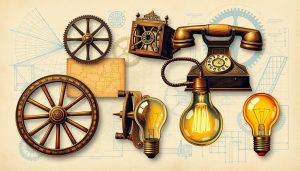
Since ancient times, many inventions have changed the world. They have helped advance human progress. Each invention was an important step toward the future.
The Sumerians created writing in 3200 BC with cuneiform characters. The wheel, also theirs, changed transportation and industry in 3000 BC.
Johannes Gutenberg innovated printing in 1450 with the movable type printing press. Benjamin Franklin harnessed electricity in 1750, paving the way for many innovations.
Karl Benz invented the automobile in 1886. Joseph Niepce took the first photograph in 1826. Jacob Perkins created the refrigerator in 1834.
Elisha Graves Otis created the first safe elevator in 1852. Alexander Graham Bell connected the nation with the telephone in 1876. These inventions changed cities and global communication.
These milestones demonstrate humanity's quest to overcome challenges. From Gutenberg to the digital revolution, these advances have shaped our society. They continue to inspire new innovations.
The Origin of Human Creativity and the Capacity to Innovate
Humanity's creative journey is rich and varied. It is filled with moments of enlightenment and world-changing innovations. human creativity comes from genes and lifelong experiences. This mystery between nature and nurture shapes individuals and civilizations.
Curiosity and the ability to create are essential for evolution. They are not only for survival, but also for cultural and social growth. The creative process involves preparation, incubation, illumination, and implementation, transforming ideas into reality.
Neuroscience helps us understand how the brain creates. This improves education and creates an environment for innovation. Men and women have always explored the capacity for abstraction to create and collaborate.
In the modern company, creativity is valued. Leaders and teams are encouraged to be creative. Companies like Amazon and Google demonstrate how creativity leads to innovative solutions.
However, Brazil still doesn't value creative education as much as other nations. Creativity is crucial to solving global problems. Understanding and fostering creativity is essential for progress.
Inventions that Formed the Basis of Modern Civilization
A series of inventions has changed how societies live and communicate. These advances have helped create important technologies and systems for our time.
Papyrus and Parchment: The Beginning of Written Documentation
Papyrus was invented in Egypt more than five millennia ago. Parchment arrived in the 2nd century. They allowed for hieroglyphic and textual writing, essential for transmitting and preserving knowledge.
These innovations were vital to scientific and cultural progress. They laid the foundation for the organization and growth of societies.
The Wheel and its Influence on Transportation and Industry
The wheel was one of the Sumerians' greatest discoveries, dating back to 3500 BC. It not only improved transportation, but also aided in the production of pottery and industrial mechanisms.
The wheel increased efficiency in production and logistics, boosting progress in various industrial sectors.
Great Global Inventions That Strengthened Trade and Navigation
Great inventions changed the world. They shaped politics and contributed to economic and cultural growth. Portugal was one of the first to navigate the world. This was made possible thanks to the Avis Revolution, which brought political stability.
The great global inventions changed history. The compass and shipbuilding improved. This allowed the Portuguese to explore new territories. They reached the Indies, opening new trade routes.
Christopher Columbus reached America with the help of Spain. This voyage changed the world. It helped unify Spain and expand global knowledge.
The Great Navigations were essential for modernity. Great global inventions and discoveries facilitated trade. They also helped exchange ideas and knowledge, advancing culture and technology.
Revolutionary Discoveries in Materials Science
Seeing the evolution of materials shows how scientific advances and technological innovations change our lives. These discoveries not only increase our knowledge. They also make our daily lives much easier.
Glass: Transforming Visibility and Conservation
Glass was invented around 2000 BC. It changed many things in our lives. Today, it's essential in many products, from preserved foods to smartphone screens. The way we make glass shows how science continues to advance.
Metamorphoses in Lighting: From Edison Bulb to LED
Since Thomas Edison created the electric light bulb in 1879, lighting has changed a lot. The LED is a major breakthrough, with a number 6 in energy efficiency. This progress has improved lighting and saved energy, demonstrating the union of sustainability and innovation.
The Steam Revolution and the Emergence of Modern Industry
The invention of steam engines was a historic milestone. It changed industrial technology forever. Thomas Newcomen's 1698 engine was the foundation. James Watt perfected it in 1765, starting the First Industrial Revolution in England.
This technology increased the production of coal and iron, which were essential for the machines and infrastructure of the time. Between 1760 and 1850, Western Europe underwent significant changes, shifting from artisanal to industrial methods.
The Second Industrial Revolution began in the 19th century. It brought innovations to the world, such as the combustion engine and electric motor. These innovations helped create new industries, such as the automobile and chemical industries.
This era of innovation paved the way for the future. It was fundamental to the Third Industrial Revolution. This revolution brought electronics, information technology, and biotechnology to transform society.
Today, we still see the impact of these historical landmarksInnovation and technological development continue to shape industry. The steam engine was an important precursor to industrial practices today and in the future.
The Lasting Impact of Gutenberg's Press
Johannes Gutenberg changed the world in the 15th century with the movable type printing press. This enabled the mass production of books. Thus, books became cheaper and more accessible to everyone, changing the way we learn.
Accessible Literature: Democratization of Knowledge
Gutenberg's printing press made books available to everyone, not just the wealthy. This helped advance education and culture. More people began reading and discussing science and literature.
The Role in Reform: Social Movements and Education
Gutenberg's printing press was also important in the Protestant Reformation. It helped Martin Luther spread his ideas rapidly. This challenged the Catholic Church and helped lay the foundations for modern democracies.
Gutenberg's printing press is an example of how technology can change history. It demonstrated the power of innovation in education and society.
The Great Global Inventions in the Field of Communication
Communication technologies have changed the world. They've improved the way we share information. And they've also created new ways for us to interact socially over the years.
The Emergence of the Telephone
Antonio Meucci is credited with inventing the telephone in 1860. But Alexander Graham Bell was officially credited with inventing it in 1876. This invention changed the way we communicate with people far away.
The Invention of Television and the Information Age
Television changed visual and auditory communication. The BBC began broadcasting in 1933, with 405 lines of resolution. This marked the beginning of the information age.
Television brought entertainment and news to the world. It also shaped mass culture and public opinion.
These inventions show progress and change. They use the number 9 to show its impact and effectiveness.
The telephone and television paved the way for further innovations. They changed society and culture. And they still influence our interactions today.
The Advancement of Transportation and the Invention of the Airplane
The invention of the airplane was a major historical milestone. It changed the way we view time and distance. Since the first flights, aviation has evolved significantly, becoming fast and safe.

Human progress has always been linked to transportation. Maritime navigation and the Industrial Revolution were important steps forward. But it was the airplane that changed everything, enabling unprecedented global connectivity.
Today, aviation faces new challenges. It seeks cleaner fuels and improved efficiency. IATA predicts major changes, such as the use of satellites and solar energy.
In Brazil, air transportation is booming. Airports like Guarulhos and Galeão are developing. This is essential to unite the country and compete globally.
Thus, the airplane changed the world. It is a symbol of innovation and progress. Its history is an example of how great inventions impact our society.
Gunpowder and the Transformation of the Art of War
Gunpowder was a revolutionary discovery of history. It emerged in the Tang Dynasty, in the 9th century. Chinese alchemists created it out of curiosity and experimentation.
In warfare, gunpowder changed everything. It changed combat techniques and the way we thought about war. This marked the beginning of a new era, lasting until the mid-19th century.
During the Song Dynasty, between the 10th and 13th centuries, gunpowder became more sophisticated. The first cannons and rockets were created. This increased the range and impact in battles.
The Wujing Zongyao manuscript, dated 1040, highlights the importance of gunpowder in warfare. It details the formula and its military role.
Gunpowder arrived in Europe in the 13th century. It changed battles and brought pioneering achievements in military technology. World Wars I and II demonstrated the impact of gunpowder.
Today, gunpowder has been replaced by more effective weapons. But its influence on the history of warfare is undeniable. It has driven advances in many fields, such as medicine and cybersecurity.
Studying the evolution of the art of war is fascinating. It evolved from direct confrontations to complex operations. Gunpowder shaped military history and changed how humanity approaches combat.
From Electricity to the Digital Age: Electronics That Shaped the 20th Century
The 20th century was a time of great change. Electricity began to be used in homes in the 19th century. This led to many innovations that paved the way for the digital age.
From the first light bulb in New York to modern computers, electricity has been essential. Edison's first power plant, Pearl Street Station, lit 400 bulbs in 1882. Today, Brazil generates 142,610 megawatts of electricity.
The Invention of the Personal Computer and the Computer Revolution
Charles Babbage and figures like Steve Jobs and Bill Gates created the personal computer. These devices transformed access to information. They are essential for business, education, and entertainment.
Internet: Borderless Connectivity and the World Around Us
The internet began with military projects and research in the 1960s and 1970s. Tim Berners-Lee took it public in 1992. It changed how we share information and connect with the world.
The 20th century gave us essential tools. Today, it's hard to imagine life without them. These advances continue to shape our future, demonstrating the importance of research and development.
Great Pioneering Achievements and Futuristic Development
Today, the technological innovations are on the rise. Advances that once seemed like science fiction are now reality. Technology is changing society, as we see with the ENIAC.
ENIAC: Pioneering Computing
The ENIAC was a major revolution in computing. Created in the 1940s, it was the first large electronic computer. It paved the way for modern computers.
This innovation not only accelerated computing but also brought progress and efficiency. These benefits are still felt today.
The Promises of Artificial Intelligence and Industrial Automation
Today, artificial intelligence (AI) and industrial automation are essential. They promise to significantly change the future. These technologies, which began centuries ago, are advancing rapidly.
They improve industrial efficiency, increase productivity, and reduce waste. AI can change how we interact and work.
The union of technology and the future is shaping the world. We are living in a moment similar to that of ENIAC. The number 13 now symbolizes advancements and a new technological beginning.
Conclusion
The history of great inventions shows how humanity has progressed. From the use of papyrus to modern vaccines, each discovery was an important step forward. They demonstrate human creativity and ingenuity.
The steam engine changed industry. The power loom increased textile production. And gas streetlights brought nightlife to cities.
Today, inventions continue to amaze and improve our lives. Custom-made pants technology is one example. It demonstrates how we can create creative solutions for market needs.
Products and services for healthcare, education, and sustainability are also important. They demonstrate how society uses knowledge and technology to grow sustainably.
Every invention, whether a printing press or a robotic machine, is an important step. They define how we live today. The pursuit of progress and improvement will continue, leaving a legacy for future generations.