THE augmented reality (AR) is changing how we interact with the world. It unites the digital and the real, creating unique experiences across multiple industries. This demonstrates the power of technological innovation today.
At home, home decor apps use AR to showcase furniture before purchase. This demonstrates how AR is changing our daily lives. Industry, medicine, retail, and education are also being transformed by AR.
Challenges such as improving hardware and creating content for AR still exist. However, companies like Google, Apple, and Microsoft are leading the way with new developments. The AR market is expected to grow significantly, reaching US$1,400,000 by 2024.
Millions of people already use AR, especially in games that create virtual worlds. In advertising, AR improves the shopping experience, increasing conversion rates. This demonstrates the positive impact of AR across various industries.
AR also improves efficiency in industrial production. It helps with prototype visualization and technical support. Integrating AR with other technologies is crucial to business success.
Introduction to Augmented Reality
THE augmented reality is a technology that enhances our vision by adding digital elements to the real world. It uses AR devices such as smartphones and special glasses. This creates an immersive and intuitive experience.
Firstly, the augmented reality It was popularized by games and social media apps. Now, it's much more than just entertainment. It's used in education, medicine, and engineering, demonstrating its great potential.
Augmented reality allows digital information to be superimposed on the real world, creating dynamic interactions between the two. For example, in AR-assisted surgeries, accuracy and safety are improved. In architecture and design, it allows projects to be visualized integrated into the real environment, enabling real-time adjustments.
Today, augmented reality is evolving rapidly. It plays a crucial role in various areas of human life. Combined with other technologies, augmented reality is poised to lead the next wave of innovation. It will become essential for a more digital and connected reality.
The historical development of Augmented Reality
THE History of AR is full of innovations that have changed how we interact with digital. Since the first augmented reality prototypes up to modern systems, this technology has evolved a lot.
Early prototypes and military advances
A major milestone was the invention of the Sensorama in 1957 by Morton Heilig. It is considered one of the first immersive multimedia systems. In the 1960s, Ivan Sutherland created an optical device that displayed virtual objects in the real world.
Military applications soon followed. They used augmented reality for simulation and training. Precision and rapid response were essential to operations.
The evolution of Head-Mounted Displays (HMD)
HMDs show the advancement of AR technologyEarly models superimposed simple images. Now, we have augmented reality glasses that blend physical reality with interactive virtual elements.
The development of HMDs was crucial to the advancement of augmented reality. It has benefited many fields.
Augmented Reality in entertainment and other sectors
Augmented reality first became popular in entertainment. Games like Pokémon Go are a good example of this. But it has also spread to sectors like education, medicine, and industrial design.
This expansion was made possible by the constant development of technology and the creation of more advanced prototypes.
With this innovative trajectory, augmented reality proves it's more than just entertainment. It's essential for improving digital and physical interactions in our daily lives.
Technology behind Augmented Reality
Augmented reality has changed a lot since its inception. It uses advanced devices and AR platforms to create unique experiences. Since the game "Magic: The Gathering," it has changed entertainment, education, and engineering.
Today, the AR platforms use sensors and advanced software. This makes interactions more immersive and accurate.
AR devices and platforms
There are many devices that support augmented reality. These include smartphones and special glasses with cameras and sensors. They use algorithms to display virtual information in the real world.
With the emergence of smartphones, technology has become very popular. These devices have powerful cameras and sensors for AR advanced.
AR Tools: From Markers to Spatial Mapping
Augmented reality tools have improved dramatically. They started with simple markers like QR Codes. Now, they use spatial mapping and environment recognition.
These tools are essential for placing virtual objects in the real world. They allow for more fluid and realistic interaction. Augmented reality in apps and games demonstrates its versatility and engagement.
Integration with sensors and hardware components
The augmented reality experience is enhanced by sensors and hardware. Devices with GPS, accelerometers, and gyroscopes detect movement and orientation. This adjusts the virtual information as the user moves.
Those sensors for AR are crucial for accuracy and immersiveness. They make AR platforms powerful tools in many industries.
Observing the development of augmented reality technology, we see its great potential. It promises to continue changing interactions with the digital world.
Practical Applications of Augmented Reality
To the augmented reality applications are changing the world. They superimpose digital information onto the real world. This makes immersive technology transform industries and improve our daily lives.
In Industry 4.0, augmented reality is essential. It improves employee training and simulates processes. This increases efficiency and reduces errors.
In healthcare, augmented reality is revolutionizing medical procedures. Doctors use 3D images to plan surgeries. This reduces risks and improves patient outcomes.
In teaching, the immersive technology makes learning more fun. Students explore anatomical structures and physical phenomena. They also take virtual tours of historical sites with their devices.
In tourism and entertainment, AR experiences enrich visits to historic sites. They offer visually appealing and educational content. This transforms visits into educational adventures.
In marketing, the augmented reality applications Create innovative campaigns. They allow consumers to see products in their space before purchasing. This improves purchasing decisions and increases customer satisfaction.
Augmented Reality in Medicine
THE medical innovation Augmented Reality (AR) has changed a lot. It helps diagnoses and surgeries with greater precision. It also creates advanced virtual training, essential for today's medical education.
To the AR diagnostic tools are doing amazing things. For example, VeinViewer helps find veins in real time. This makes procedures like needle insertion safer and more effective.
Innovations in surgery and medical training
AR is changing surgeries by allowing us to see inside a patient's body in real time. This improves accuracy and reduces risks. AR in medicine It also changed medical education. Students can perform surgeries in a safe environment, without risk to real patients.
VeinViewer and other AR tools for diagnosis
The impact of AR in medicine is a big part of clinical practice. VeinViewer is an example of how technology helps with diagnosis and treatment. These devices make treatments more efficient and improve the patient experience.
AR holds great potential for the future of medicine. It promises to change the way medicine is practiced and how medical knowledge is passed on to new professionals.
Augmented Reality in Education
THE Augmented Reality (AR) is changing the way we teach. It makes learning more immersive and dynamic. Use AR in education increases student interest and improves performance.
THE AR educational technology makes complex concepts visible. This helps to understand them better and more directly.
THE AR in education blends the real world with the digital. It offers experiences of immersive learning unique. With it, it is possible to learn theory and practice, such as the human body in anatomy.
Experiences like virtual tours of historical monuments are possible with the help of apps, such as Google Earth 3D and the Human Anatomy Atlas.
The impact of AR educational technology It's a big one. Many schools are adopting it to stand out. They've seen an increase in student achievement and teaching quality.
Furthermore, the FROG Allows for group distance learning. This improves digital education, inclusion, and accessibility.
Therefore, the Augmented Reality in Education It's more than a trend. It's an essential pedagogical evolution. It puts students at the center of learning, making it more engaging, interactive, and effective.
Augmented Reality and the Entertainment Sector
Augmented Reality (AR) is changing entertainment. It's used in games and AR tourismThis allows people to interact and experience content in a unique way.
Games like Pokémon Go demonstrate the power of AR. They don't just bring people together in open spaces. They also bring culture and history into the game, educating and exploring places.
AR games like Pokémon Go and their implications
Augmented reality games are highly interactive. They easily connect the virtual world to the real one. This allows people to see their cities in new ways, capturing characters and solving mysteries.
Immersive experiences in museums and tourism
Museums and tourist sites use AR to tell engaging stories. Using mobile devices, visitors can see historical or artistic details that might otherwise be invisible. This enriches the tourist and educational experience.
AR is improving tourism. It makes tourism more interactive and informative. This marks a new chapter in the experience of local culture and history.
Augmented Reality in Industry and Engineering
THE AR in industry is changing everything. It brings innovations that transform industrial processes. With advanced industrial technology and augmented reality, factories become smarter and more productive.
In Industry 4.0, this technology is a huge help. It makes automation and system interconnection easier. This reduces the need for human intervention.
In the engineering and AR, things get even more impressive. Engineers use augmented reality to place 3D models in real locations. This helps catch design flaws before anything is done.
This practice saves time and resources. It also improves accuracy in planning and construction.
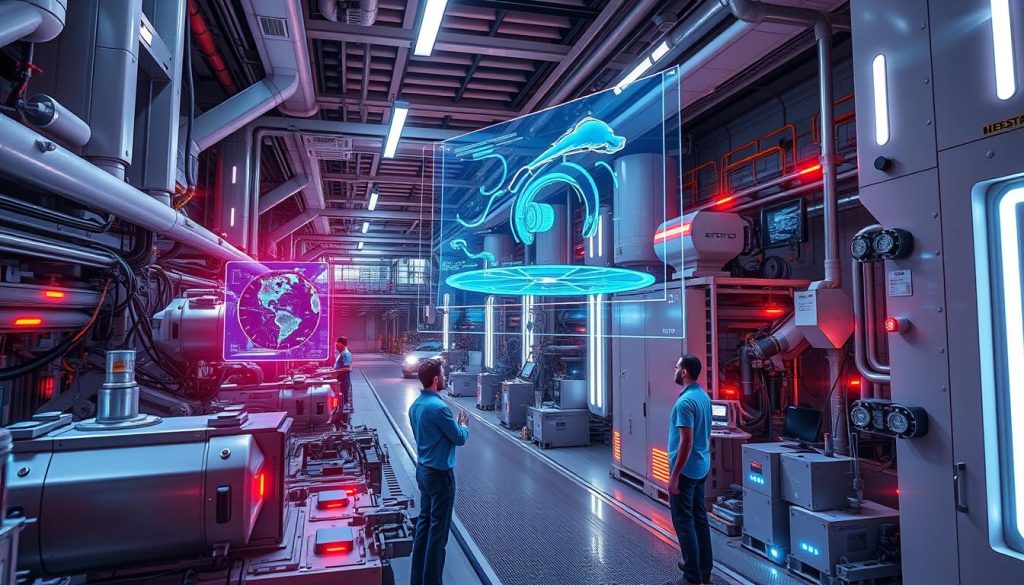
THE AR in industry It also improves assembly and maintenance. Technicians receive detailed instructions directly at the work site. This reduces errors and downtime, increasing productivity.
Companies that use augmented reality see significant improvements. They save time and money. The technology becomes a valuable investment.
However, adopting this technology presents challenges. The initial cost is high, and specialized training is required. But the long-term benefits are significant, including increased efficiency, safety, and competitiveness.
Augmented Reality in Commerce and Marketing
THE augmented reality is changing commerce and marketing. It allows companies to create unique shopping experiences. This effectively attracts and retains consumer interest.
IKEA is a great example. They created a tool for customers to see how their furniture would fit into their homes. This shows how augmented reality can make purchasing more interactive and personalized.
AR tools for shopping simulation and brand experiences
Amazon and Sephora are leading the way in using augmented reality to improve online shopping. Amazon lets users see how products would look in their homes, while Sephora has an app for virtual makeup try-ons.
Impact of AR on advertising campaigns and consumer engagement
Augmented reality is changing advertising. It creates emotional connections with consumers in new ways. This is evident in the increased investment in AR marketing.
These campaigns improve brand visibility and engagement via ARThis is especially true for younger audiences who seek immersive experiences.
The augmented reality market is growing at a rate of 13,721 TP3T per year. This demonstrates that the technology is becoming more mainstream in commercial strategies. Augmented reality is setting new standards for customer-brand interactions and changing the future of digital shopping experiences.
Recent Advances in Augmented Reality Devices
Technological advances in AR devices are changing the digital world. Apple has launched Vision Pro, a AR glasses innovative. It combines the virtual and the real in an incredible way, improving the user experience.
This innovation demonstrates the industry's commitment to creating advanced products. They want these devices to become part of our daily lives.
Meta also entered the scene with the Quest Pro. This device features a powerful Snapdragon XR2 Gen 2 processor. It's perfect for popular games and apps.
This launch shows that augmented reality is becoming more practical. It's expanding beyond entertainment to professional simulations and education.
You AR glasses are becoming more comfortable. They are lighter and more ergonomic, which helps in the adoption of these technologies.
People are really looking forward to the next versions of these AR devicesThey have the potential to change many industries and create immersive experiences that previously seemed impossible.
Augmented reality and its contributions to digital transformation
Augmented reality (AR) is joining forces with artificial intelligence (AI) to transform businesses. This combination, called AR integration with AI, helps companies innovate. They can improve their products and services, creating a richer user experience.
Integration with other immersive technologies and Artificial Intelligence
THE AR integration with AI creates advanced solutions, ranging from interactive training to remote maintenance. This significantly improves business.
For example, AR software helps companies better understand their operations. Technology companies use these tools for simulations and training. This increases efficiency and reduces costs.
How AR is shaping business models and operational processes
AR is changing how companies do business. In real estate, customers can view properties before buying. This changes purchasing decisions.
In construction, AR improves maintenance. It displays internal components and instructions in real time. This reduces errors and improves safety.
These examples demonstrate how AR improves efficiency and engages consumers. It demonstrates AR's transformative potential for business.
Conclusion
Augmented Reality (AR) has been growing rapidly since its early days. It's now found application in areas such as education, healthcare, and entertainment. AR brings virtual information and elements into reality, improving human-machine interaction.
In industry, AR brings significant benefits. It improves process efficiency and safety. Technicians use AR to diagnose and repair work without interrupting production.
Expectations are that AR will continue to grow. It will help in digital transformation of companies. AR will blur the lines between the physical and digital. It is essential for a more integrated and interactive society.